
How to Play the Tawar Ras Game
The hands-on guide to getting started and knowing exactly what to do at every step.

Some links on this page are affiliate links. We may earn a commission at no extra cost to you. Full disclosure
Your First Game of Tawar Ras
The Tawar Ras game is a crash game. You stack floors on a tower, each floor raises a multiplier, and you need to cash out before the whole thing collapses. Simple in theory, but in practice there are quite a few things worth knowing. Check our detailed game features guide for a deep dive into the mechanics before you start.
Here's how to get started:
- Find the game: Head to an online casino that offers Tawar Ras (Galaxsys). Look in the "crash games" section or type the name in the search bar.
- Try the demo first: Before reaching for your wallet, play in Tawar Ras free demo mode. It's the exact same game, same bonuses, same mechanics - just with virtual credits.
- Play 15-20 free rounds: The goal is to get a feel for the game's rhythm. Notice how unpredictable the collapses are. Test different cash-out points.
- Switch to real money: Once you're comfortable, deposit an amount you're fully prepared to lose. Not a penny more.
Something most beginners skip: mentally tracking what multiplier the tower collapses at during your first few games. It helps set realistic expectations.
Playing the Tawar Ras Game Step by Step
Choosing your bet
Bets range from ₹10 to ₹50,000. As a beginner, stay on the low end. Personally, I recommend sticking to the minimum bet for at least 30 real-money rounds. It gives you time to find your rhythm without burning through your budget.
A simple rule of thumb: your bet should be no more than 2% of your total session budget.
Building floor by floor
Each click adds a floor. The multiplier climbs. This is where the tension builds, because every click could also trigger a collapse.
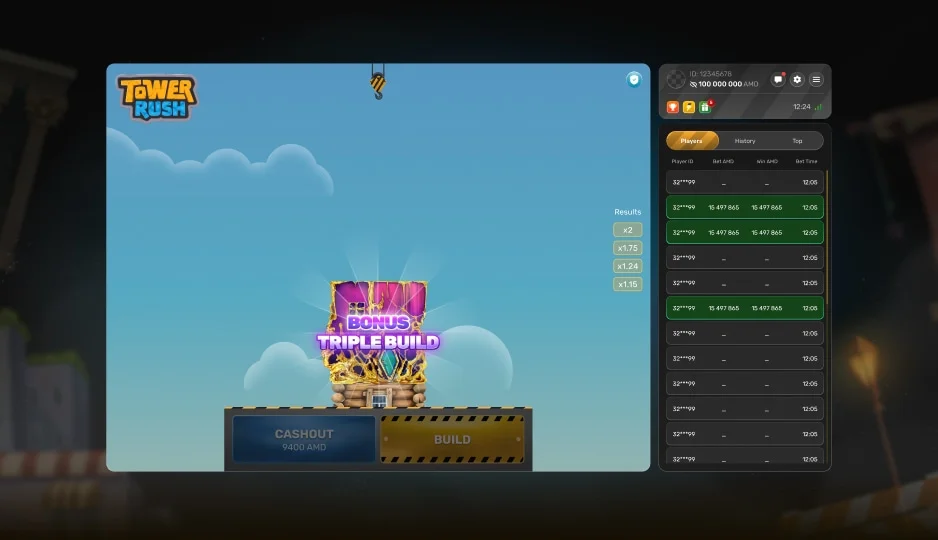
What the game doesn't make obvious: the collapse point is already determined before you click. The RNG has decided - you're just revealing the outcome. That means there's no magic "timing" - every round is completely independent.
When to cash out
This is THE decision in the game. You hit the cash out button, your winnings are credited, and the round is over. No going back.
The classic trap: you're sitting at 8x and think "just one more floor." Then at 9x, same thing. And at 10x, the tower falls. Set a target BEFORE you start each round. "This time, I'm cashing out at 5x." And stick to it.
When the tower collapses
Your bet is lost. That's it. No second chances, no do-overs. The game takes you straight back to the betting screen for the next round.
The reflex to absolutely avoid: doubling your bet on the next round to "make it back." That's the most dangerous spiral in crash games.
Tawar Ras Is Provably Fair — Not a Skill Game
This is the single most important thing to understand about Tawar Ras: it is not a skill-based game. No amount of practice, timing, or strategy changes the outcome of any round. The result is determined entirely by a certified Random Number Generator (RNG) before you even place your first block.
Block placement doesn't matter
When you click to add a floor, you might feel like you're "building" something — choosing when to place each block, timing your clicks carefully. But here's the truth: it doesn't matter where, when, or how you click. The collapse point is already decided the moment the round begins. Whether you click fast or slow, wait 10 seconds between floors or spam the button — the tower will collapse at the exact same point regardless.
The building animation is purely visual. You're not constructing anything — you're revealing a predetermined outcome, one floor at a time.
What "provably fair" actually means
Tawar Ras uses a provably fair system, which means every round's outcome can be independently verified. Before the round starts, the server generates a hash of the result. After the round ends, you can check that hash against the actual outcome to confirm the casino didn't tamper with it. This is a cryptographic guarantee — not a marketing claim.
Galaxsys, the developer behind Tawar Ras, holds gaming licenses that require regular third-party audits of their RNG. The system is tested to ensure that outcomes are statistically random and that no pattern exists between rounds.
Why this matters for you
- No "hot" or "cold" streaks: If the tower collapsed at 2x five times in a row, the next round is just as likely to collapse at 2x again. Past results have zero influence on future rounds.
- No timing tricks: Clicking faster, slower, or at specific intervals has no effect on the outcome. The animation responds to your clicks, but the math behind it doesn't.
- No learning curve that changes your odds: An experienced player and a first-timer have the exact same probability of winning on any given round. Experience only helps with bankroll management and knowing when to cash out — not with changing the game's math.
- The house always has an edge: Like all casino games, Tawar Ras has a built-in house edge (typically around 3-4%). Over thousands of rounds, the casino will always profit. Short-term wins are possible, but no strategy can overcome this edge in the long run.
Understanding this isn't meant to discourage you — it's meant to protect you. Players who believe they can "master" crash games through skill tend to chase losses and overspend. Players who understand the RNG play within their budget, enjoy the game for what it is, and walk away when they've had enough.
Tawar Ras Bonuses: Reacting in the Middle of a Round
Three bonuses can appear while you're playing. Here's exactly what to do when each one shows up.
Frozen Floor - What to Do

When the Frozen Floor triggers, you have 3-5 seconds of safety. Above 5x? Cash out. Below 3x? Keep building — the collapse odds are still low.
Temple Floor - What to Do
Build 3-4 floors during the Temple bonus, then cash out. The boosted multiplier is tempting but the tower can still collapse. Don't push past 5 floors.
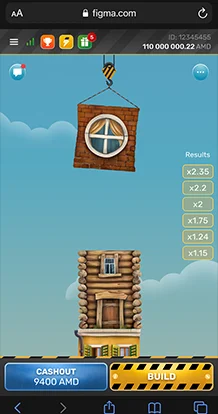
Triple Build - What to Do

Early game? Great — three free floors with low risk. Late game above 15x? Cash out immediately after the Triple Build lands.
For a full breakdown of how each bonus works, see our game mechanics guide.
Tawar Ras Strategy: Which Style Fits You
The "small, steady wins" approach
Cash out consistently between 2x and 3x. You win often, in small amounts. It's not the most exciting, but it preserves your bankroll.
In practice, it looks like this: bet ₹100, cash out at 2.5x, profit of ₹150. Over 10 rounds, you'll probably win 6-7 and lose 3-4. The net profit is thin, but it's consistent. This is the strategy I recommend for your first real-money sessions.
The "fixed target" approach
You pick a target multiplier before each round - say 7x - and cash out the moment you hit it, no exceptions. No "just one more floor."
The upside is discipline. You take emotion out of the equation. The downside is that sometimes the tower collapses at 6.8x when your target was 7x. That stings, but over the long run, having a clear rule delivers better results than deciding on a whim each time.
The "adaptive" approach
You adjust your cash-out point based on what's happening in the round. If a bonus appears early, you push a little further. If nothing happens after 8-10 floors, you cash out.
This is the most engaging strategy to play, but also the riskiest. It requires discipline because "I'm adapting" can quickly turn into "I always push one floor too many." If you go with this style, still set an absolute ceiling (say 20x) beyond which you cash out no matter what.
What doesn't work
Martingale-type systems (doubling your bet after every loss) don't work on Tawar Ras. Mathematically, the house edge stays the same regardless of your betting sequence. Increasing after a loss only speeds up how fast you drain your budget. Read our responsible gaming guide for tips on managing your bankroll safely.
Same goes for "patterns": if the tower collapsed at 2x on the last three rounds, that doesn't mean it'll go high on the next one. Every round is independent.
Mistakes to Avoid on Tawar Ras
- Playing without a set budget: Decide on the total amount before you open the game. When it's gone, it's gone. No "just ₹500 more."
- Skipping the demo: You have nothing to lose by playing 30 rounds in the free demo. It saves you from paying to learn the basics.
- Chasing losses: After three collapses in a row, the urge to raise your bet is strong. That's exactly when you should take a break. Our responsible gaming page has practical tools to help you stay in control.
- Ignoring bonuses: When a Frozen Floor triggers, don't just sit there. Actively decide whether to cash out or keep going.
- Playing tired or frustrated: Impulsive decisions in crash games are expensive. If you're not in the right headspace, close the game.
- Comparing your results to others: Every session is different. The player who hit 50x yesterday probably lost on the 15 rounds before that.
FAQ: Playing Tawar Ras
Where do I start if I've never played Tawar Ras before?
Head to a casino that offers the game, create an account, and launch the demo version. You don't need to deposit anything to try it out. The demo works exactly like the real game, except you play with virtual credits. Play at least 20-30 rounds in demo mode before switching to real money.
How much should I budget for a gaming session?
It depends on your style. If you play conservatively (cashing out at 2x-3x), a budget of 20-30 times your bet is enough for a decent session. If you're aiming higher, plan for 50 to 80 times your base bet, because losing streaks happen more often. Decide on the amount before you launch the game and stick to it.
Can the tower collapse on the very first floor?
Yes, it's rare but it happens. The RNG determines the collapse point before you even click. So every click carries risk, including the very first one. That's why you should always play with a bet you're prepared to lose entirely.
Should I change my bet between each round?
Not necessarily. Most regular players keep a fixed bet and only adjust it based on their total bankroll. Increasing your bet after a loss to "win it back" is the worst thing you can do - it speeds up your losses without improving your odds.
How can I tell if a bonus is about to appear?
You can't. Bonuses are triggered by the RNG independently on each floor. Building 30 floors without a bonus doesn't "guarantee" one will appear on floor 31. Play as if no bonus is coming, and treat them as a lucky break when they show up.